Catalogues
Ward Printed One Sheet
Aaron Montgomery Ward's single-page catalogue of 1872 — what it listed, who it was aimed at, and why a sheet of paper was a commercial argument in itself.

Ward's 1872 list ran to a single page; its argument was that a printed price needs no shopkeeper standing behind it.Photo: Antoni Shkraba / Pexels
A single page mailed in 1872 became the founding document of the mail-order industry — not because of what it sold, but because of what it promised.
The Sheet Itself
Aaron Montgomery Ward printed his first catalogue in 1872 from a loft at 825 North Clark Street in Chicago, Illinois. It was not a catalogue in any architectural sense — no spine, no index, no illustrations. It was a single sheet of paper, approximately eight inches by twelve, listing roughly 163 merchandise items with their prices. Dry goods, notions, and farm supplies occupied most of the list. The prices were marked plainly. There was an address to which orders could be sent, and a guarantee: goods could be returned if unsatisfactory.

A century of retail, filed by year.
Photo: Mathias Reding / Pexels
That guarantee was the argument. Ward was selling to members of the Patrons of Husbandry — the Grange — a national organization of rural farmers who had grown systematically distrustful of local merchants and their markup practices. The Grange had been founded in 1867, and by the early 1870s it had organized buying cooperatives in an attempt to eliminate the intermediary profit that inflated the price of nearly everything a farm family needed. Ward understood this grievance precisely. He had worked as a travelling salesman across rural Illinois and Missouri and had spent time behind a dry-goods counter; he knew both sides of the counter and both sides of the resentment. The single sheet was not an advertisement in the traditional sense. It was a proposition addressed to a specific, organized audience already primed to receive it.
The logistics required to honor the sheet's promise were modest by later standards but genuinely ambitious for 1872. Ward and his partner George Thorne operated without a retail floor. Goods were purchased in volume from manufacturers and wholesalers in Chicago and shipped by rail and express — formal rural free delivery did not arrive until 1896, but the railway express companies already moved packages between town depots and rural communities. The farmhouse customer would travel to a depot or post office to collect an order, or arrange for local delivery from there. The friction was real, but it was less friction than a day's journey to a city merchant.
The Document as Argument
Reading the 1872 sheet as a primary source, what stands out is its economy. Ward committed to price on the page. There was no haggling, no relationship, no salesman to charm or be charmed by — only a printed number and a return policy. That combination was structurally radical. A fixed price on paper transferred power to the buyer, who could compare it against a local merchant's quote without the merchant present. For the Grange membership, this was not a convenience; it was an instrument of economic self-defense.
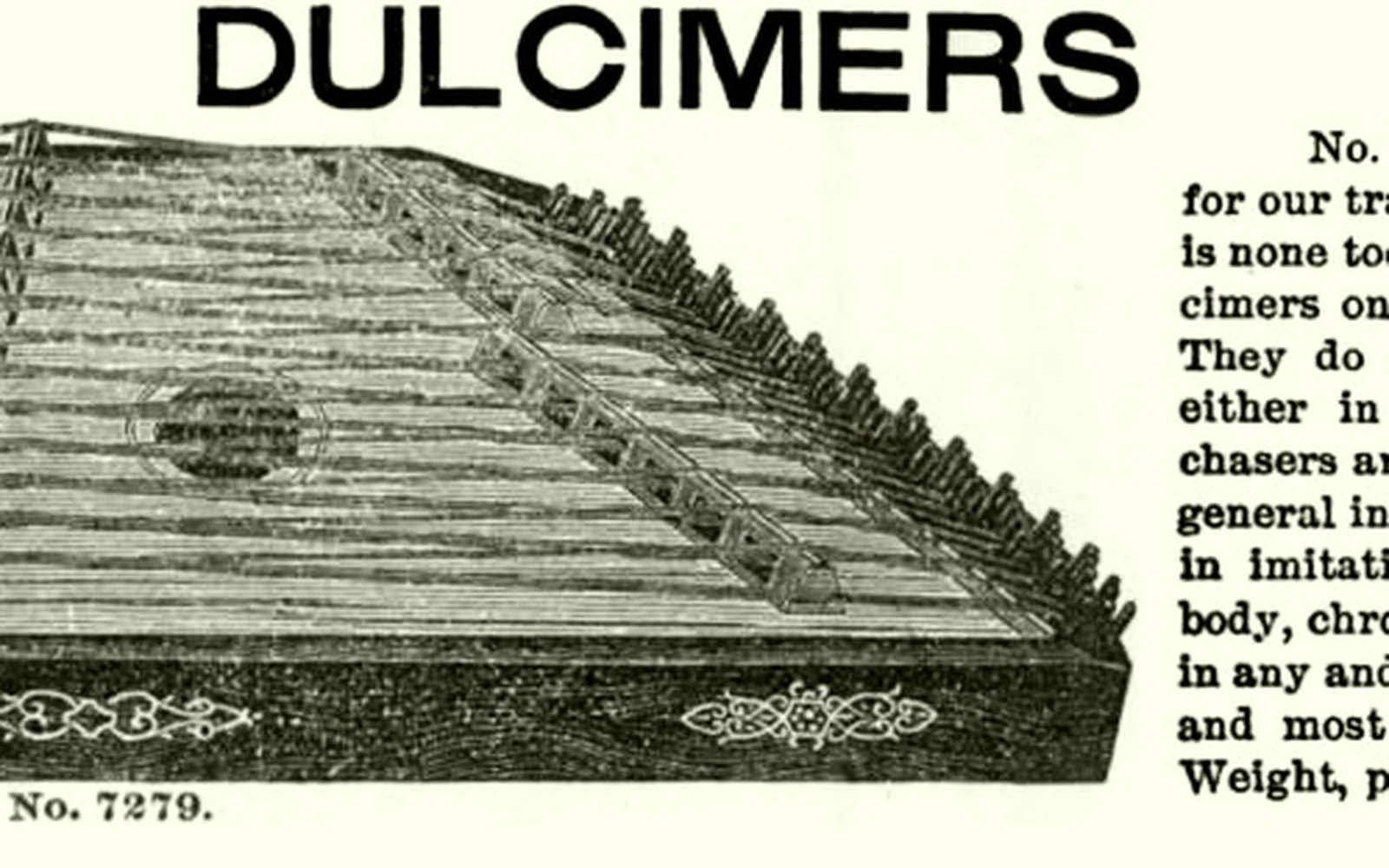
Two editions a year and roughly 500 pages by 1897 — the page count was itself the competitive claim.
Photo: Searsdulcimer · Wikimedia Commons
Ward's appeal to Grange members explicitly positioned him as a cooperative's supplier rather than an independent merchant. Early editions of the catalogue carried the phrase identifying it as a Grange supply house. The affiliation gave the document institutional credibility it could not otherwise have earned from cold. Trust, in 1872, required a social structure to anchor it; Ward borrowed that structure from an existing organization rather than building one from scratch.
By 1874 the sheet had grown to an eight-page booklet. By 1876 Ward had expanded to seventy-two pages. By the early 1880s the catalogue ran to hundreds of pages, and the Sears, Roebuck and Company catalogue — begun in 1888 by Richard Warren Sears and Alvah Curtis Roebuck — would eventually eclipse Ward's in scale and variety. But the structural logic Sears inherited was Ward's: a printed price list mailed to a defined audience, redeemable against a guarantee. Every element that would later define direct marketing — the measurable offer, the named audience, the response mechanism, the promise of accountability — was present in embryo on that one sheet.
The Parcel Post Act of 1913 would eventually make the physical delivery of catalogue goods cheap and universal, and Lester Wunderman would not name the discipline "direct marketing" until his 1967 speech at MIT. But the operating principles were already encoded in Ward's 1872 sheet: identify a dissatisfied audience, make a specific offer in print, put a price on it, and stand behind the transaction. A sheet of paper could be a commercial argument. Ward proved it.