Lists & Segments
What the Warehouse Held
Acxiom, Experian and the data-warehouse business that grew from list-broking into comprehensive consumer dossiers — the scale of what was assembled, the sources it was drawn from, and how the industry described its product.

List broking became warehousing: files assembled from public records, transactions and surveys.
From rented lists to permanent dossiers: how Acxiom, Experian and their peers turned the mailing list into something larger than any catalogue mailer had imagined.
The List Outgrows the Campaign
The mailing list was always a transactional object. A list broker rented access to a set of names and addresses for a single campaign mailing, the mailer posted its pieces, and the records technically reverted to the owner. What changed over the last quarter of the twentieth century was permanence. Companies stopped thinking of consumer data as something borrowed for a campaign and started thinking of it as an asset to be held, enriched, and sold repeatedly.

Before the file there was the drawer: the broker's card index, rented by the thousand names.
Photo: Tima Miroshnichenko / Pexels
Acxiom, founded in 1969 in Conway, Arkansas, by Charles Ward and a small data-processing team, began as a service bureau managing voter-registration and mailing files for political clients. It moved steadily into commercial list management and, by the 1980s, was operating one of the largest merge-purge and database-hygiene operations in the United States. The merge-purge problem — combining rented lists from multiple sources and stripping duplicate records before a campaign — required exactly the kind of industrial computing infrastructure Acxiom had built. Solving it for mailers gave the company access, at scale, to the raw material of consumer identity: names, addresses, telephone numbers, and transaction histories arriving from thousands of sources simultaneously.
From Post Office Box to Consumer Profile
What those sources eventually included was the more striking part. Public records supplied by county courthouses — property deeds, vehicle registrations, voter rolls — were combined with warranty-card returns, magazine-subscription files, catalogue purchase histories, credit-application data, and retail transaction records. Jonathan Robbin's Claritas PRIZM system, which had attached lifestyle-cluster labels to ZIP codes since 1974, offered a further layer: if an address could not be matched to a direct purchase record, it could at least be assigned a neighbourhood type. The resulting profile was not a list in the old sense. It was a dossier: a persistent record that followed an individual across addresses and could be updated as new data arrived.
Experian arrived at the same destination by a different route. The company grew out of TRW's credit-information division, which had been supplying consumer credit reports to lenders since the 1960s under the Fair Credit Reporting Act's predecessor regulations. When TRW's information services arm was sold in the mid-1990s and eventually rebranded as Experian, it entered the direct-marketing data market with a foundation the pure-list businesses lacked: a legally structured relationship with consumers through the credit system, and a database of financial behaviour ↗ that mail-order list files could not match in depth or coverage.
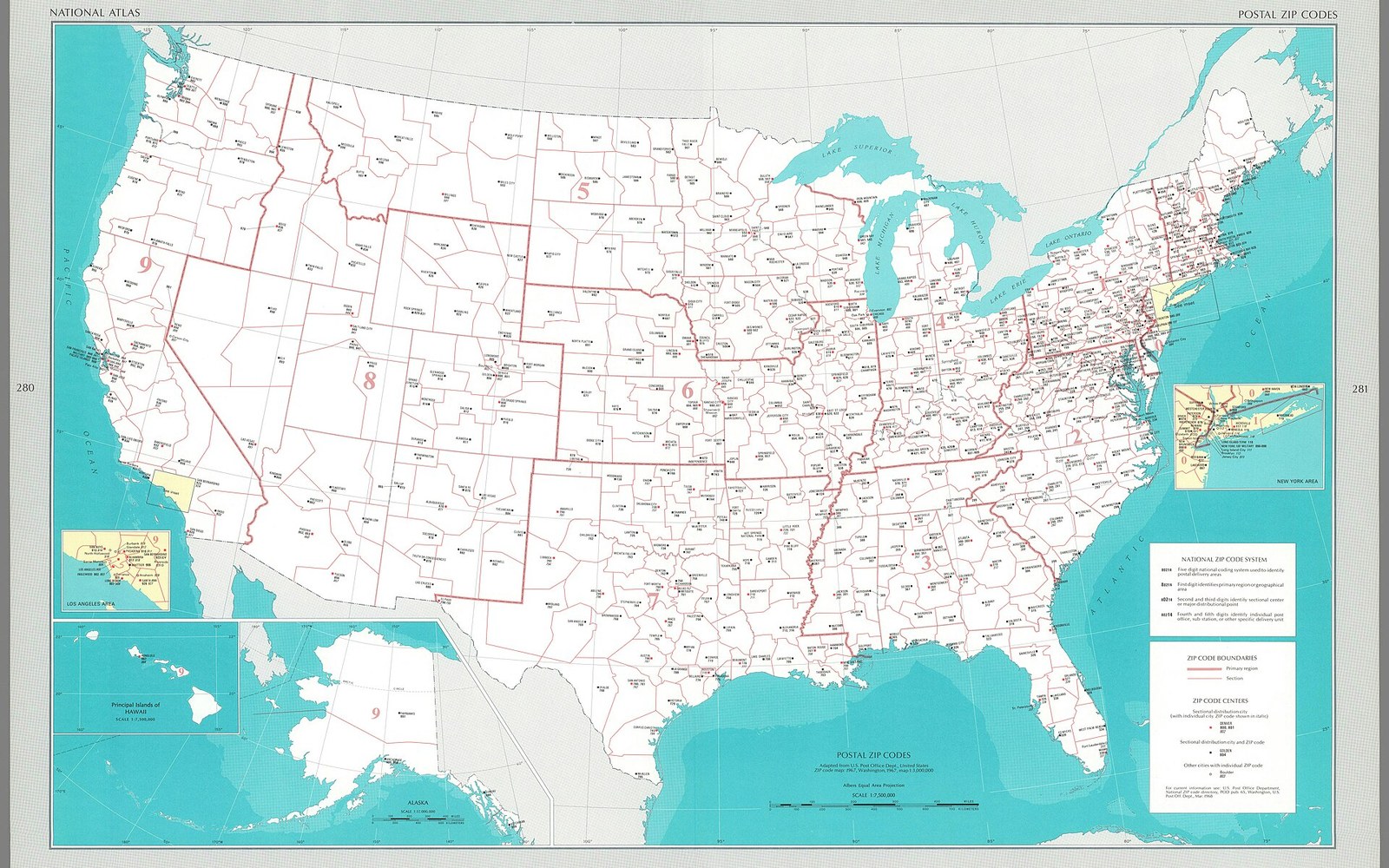
Five digits, and a mailing list could be sorted, aggregated and matched against the census.
Photo: Postal zip codes - adapted from U. S. Post Office Dept., United States ZIP code map- 1967, Washington, 1967, map 1-3,000,000. (IA dr postal-zip-codes-adapted-from-u-s-post-office-dept-united-states-zip-14359211) · Wikimedia Commons
By the early 2000s, Acxiom's own disclosures and subsequent Federal Trade Commission investigations documented a consumer database covering the substantial majority of American households, with each record carrying dozens to hundreds of individual data points. The industry's preferred vocabulary at the time was precise and value-neutral: "data enhancement," "list hygiene," "append services." A telephone number added to an address file was an "append." A consumer's estimated household income, inferred from neighbourhood and transaction data, was an "overlay." The language kept the product at one remove from the individual it described.
Scale and Its Audit
The FTC's 2014 report on data brokers — the most comprehensive public accounting of the sector up to that date — found that the nine brokers it examined held data on hundreds of millions of consumers, with one company alone maintaining more than 3,000 data segments per person. The report noted that consumers had no general right to see what was held about them, and that the data moved through the industry largely without their knowledge. PRIZM cluster codes, RFM scores, inferred life-stage categories, and purchase-propensity indices circulated as tradeable commodities among brokers, mailers, and the credit industry simultaneously.
What Acxiom, Experian, and their peers had built was, in commercial terms, the logical endpoint of a trajectory that ran from the rented mailing list through the merge-purge operation to the permanent, enriched, constantly updated consumer record. The catalogue mailer had always wanted to know who would buy. The data warehouse answered with something closer to a biography.